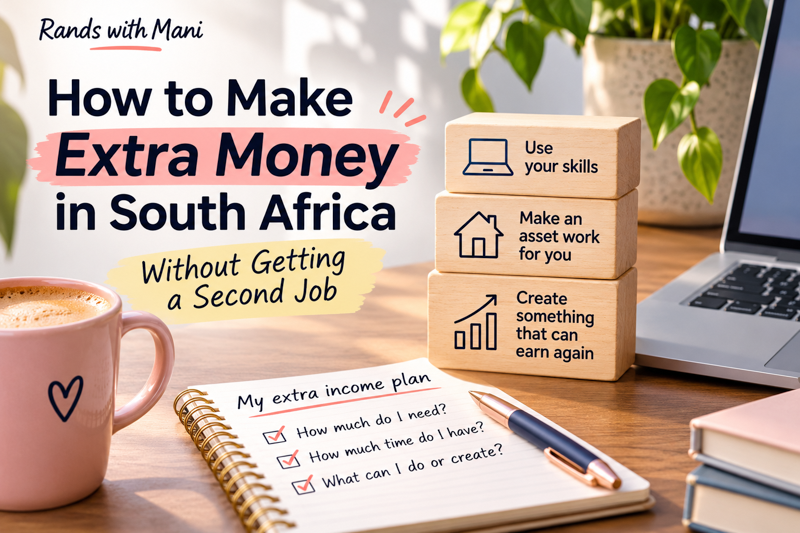
How to Make Extra Money in South Africa Without Getting a Second Job
If you need more income, the answer doesn’t always have to be “work more hours”. Here’s a practical way to build extra income around the life you actually want.
The short answer
If you’re wondering how to make extra money in South Africa, I wouldn’t begin by Googling “best side hustles”.
I would begin with three much more useful questions:
How much extra money do I actually need? How much time am I willing to give up for it? And what can I already do, own or create that somebody would genuinely pay for?
Those questions immediately narrow the field. If you need an extra R2,000 next month, the fastest solution may be selling a skill you already have.
If you want to eventually replace a salary, you probably need something that can grow beyond your own hours — a product, business, asset or system.
And if your real goal is more freedom, not simply more money, that changes the answer again. That distinction matters to me more than it used to.
I don’t actually want another job
A lot of advice about making more money sounds great until you think about what it would actually do to your life.
Someone says, “I need another R5,000 a month,” and the internet produces the usual answers: tutor after work, freelance at night, bake on weekends, become a consultant, drive deliveries, sell products online.
There is nothing wrong with any of those ideas. Some of them can work very well. But there is a question that is often missing:
Where are all these extra hours supposed to come from?
If you already work, have children, run a home and occasionally want to sit down without monetising the experience, there is a limit to how much more of yourself you can sell.
I think about income very differently now than I did earlier in my career.
After my husband died, I became much more aware of resilience. I wasn’t interested only in how much an income stream could produce. I started asking how dependent it was on me being available every day.
If I stopped working for a week, would the income disappear?
Could I still earn while spending time with my daughter?
Was I building something that could eventually make life easier, or was I quietly giving myself another job?
That last question has become a big one for me.
There are plenty of ways I could earn money by taking on clients and filling my diary with calls. That may suit somebody else perfectly. It isn’t the kind of life I personally want to build.
I would rather do work today that has at least some chance of still having value tomorrow.
That is one reason I write. It is one reason I am building Rands with Mani. An article, guide, calculator or digital product takes work to create, but the same piece of work can potentially help more than one person.
That is the kind of income model I find interesting.
Before you choose an idea, work out the problem you are actually trying to solve
“Make more money” is too vague. R2,000 extra a month and R30,000 extra a month are completely different problems.
So before choosing an income idea, pick a number. Imagine you want another R5,000 a month. Now decide how much time you are genuinely willing to give it. Suppose the answer is five hours a week. That is roughly twenty hours a month.
R5,000 ÷ 20 hours = R250 an hour.
That little calculation is incredibly useful.
It means that if an idea is likely to earn you R70 an hour, it probably won’t solve your R5,000 problem unless you are willing to give it far more time.
On the other hand, if you have a skill people will happily pay R500 an hour for, you may only need ten hours of paid work a month. Suddenly the question is no longer:
“What side hustle should I start?”
It becomes:
“What can I realistically do that produces at least R250 for each hour I’m willing to give up?”
That is much more practical.
There are really only three income models
Almost every extra-income idea fits somewhere in this table:
| Income model | What you are using | Example | Main limitation |
|---|---|---|---|
| Sell your time or skill | Your knowledge and hours | Tutoring, bookkeeping, design, consulting | Income normally stops when you stop working |
| Earn from an asset | Something you already own | Property, equipment, savings, intellectual property | Usually needs capital or an existing asset |
| Build something scalable | A product, system or audience | Templates, books, digital products, websites | Usually slower to earn at the beginning |
I don’t think one is automatically better than the others.
They solve different problems. If I needed money quickly, I would probably start with the first. If I already owned a useful asset, I would investigate the second.
If my priority was eventually having more freedom over my time, I would be trying to move towards the third. And in real life, you can use all three.
If you need money quickly, start with something you already know how to do
This is where I think a lot of people make extra income unnecessarily complicated. They decide they need more money and immediately start learning an entirely new business.
They buy a course.
They create a logo.
They design a website.
They open six social-media accounts.
Three months later, they still haven’t earned R1.
If I needed additional income fairly quickly, I would start much closer to home.
I would ask:
What problem can I already solve?
For me, that might be something related to finance, accounting, writing or analysing numbers because I already have those skills.
For somebody else it might be maths tutoring, baking, CV writing, photography, social-media admin, sewing, fitness, gardening or helping small businesses stay organised.
The point is not that your skill needs to be exciting. It needs to be useful enough that another person will pay to avoid doing the problem themselves. A good test is to finish this sentence:
“People come to me when they need help with ______.”
There is often an income idea hiding in that blank.
Make the offer specific
This is where I think people can immediately become more practical. “I’m available for freelance admin” is vague.
“I will organise your small business’s receipts and expenses into a clean monthly spreadsheet for R750” is much easier to understand.
“I do tutoring” is vague.
“I help Grade 6 maths learners prepare for tests in one-hour online sessions” is specific.
“I make templates” is vague.
“I sell a simple monthly budget spreadsheet for South Africans who hate complicated spreadsheets” tells me exactly what I am buying.
People don’t pay because you have skills. They pay because they understand what problem you are going to solve for them. That is a subtle but important difference.
Test the idea before you build a whole business around it
This may be the most practical advice in the article. Before spending months building something, try to get one person to pay for it.
Then try to get five. You do not need a logo to do that. You do not need a perfect website. You do not need a complicated business plan. You need evidence that somebody wants the thing.
If I wanted to sell a budgeting template for R150, I would much rather discover that nobody wants it after spending one weekend creating a simple version than after spending six months building an entire budgeting platform.
This is also why services can be useful even if you don’t ultimately want to sell your time forever. Working with a few real customers teaches you what people actually struggle with. Then you can turn the repeated problem into something more scalable.
The path I like: sell the skill first, then turn the repeated work into a product
Imagine you are good at bookkeeping. You find two small-business clients who each pay you R2,000 a month.
That gives you R4,000 of extra monthly income.
It requires your time, but now you are learning something valuable: what small businesses repeatedly need help with.
Perhaps both clients struggle with expense tracking. Instead of solving that same problem manually forever, you create a simple spreadsheet and instructions.
You sell the spreadsheet for R150. If 20 people buy it in a month:
20 × R150 = R3,000
Now you have two different income streams.
The service produces R4,000.
The product produces R3,000.
Total: R7,000.
More importantly, the second income stream doesn’t require you to personally redo the spreadsheet for every customer.
That is leverage.
Over time, maybe you keep the clients because you enjoy the work. Or perhaps you slowly take fewer clients and sell more products. You don’t have to decide the final business model on day one.
You can let it evolve.
This is why I’m interested in digital products
I don’t think digital products are “easy passive income”.
They are not.
You still need to create something genuinely useful. People need to discover it. You need to explain why it helps them. You may have to improve it several times.
But I like the underlying economics. If you write an ebook, you don’t have to rewrite it every time somebody buys it.
If you create a useful spreadsheet, the 100th customer can buy the same spreadsheet as the first.
If you create a children’s printable or revision pack, the product can be sold again without you sitting next to every child using it.
That is very different from selling individual hours.
But I like the idea that an article I write once can keep helping somebody who finds it six months later. I like that a guide can be downloaded more than once. I like that a book can be sold while I am doing something completely unrelated.
That doesn’t make the work passive. It makes the work reusable. I think that is a better word.
Work out the hourly value before you say yes to an idea
This has saved me from romanticising business ideas. Suppose you make a product and earn R200 profit each time you sell one. Sounds good.
But perhaps it takes three hours to make, pack and arrange delivery.
R200 ÷ 3 hours = roughly R67 per hour. If you genuinely enjoy making it, great. But at least you know what you are choosing.
Now imagine you could instead use the same three hours to do a specialised piece of freelance work for R1,500.
The comparison becomes much clearer. This doesn’t mean the highest hourly rate always wins. Maybe the R67-an-hour product business can eventually be automated.
Maybe you love doing it.
Maybe it gives you flexibility.
Money is not the only consideration.
But I would still know the number.
How much am I really earning for every hour this income stream takes away from my life?
That question cuts through a lot of side-hustle hype.
Look at what you already own before you invent more work
Making more money doesn’t always require doing more work. Sometimes it means making better use of an asset you already have.
That could be a spare room, a property, storage space, equipment, intellectual property or even cash that is sitting somewhere earning very little.
Property is a good example because the headline number can be misleading. Imagine a property brings in R20,000 rent. It is tempting to say the property earns R20,000 a month.
But perhaps you pay R2,000 in rates, R2,000 in levies, R1,000 in insurance and maintenance, and another R1,000 in management fees.
Your R20,000 suddenly looks more like R14,000 before tax. That doesn’t make the property a bad investment.
It simply means R14,000 is the number you should use when deciding whether the income is worth it.
I have become far more interested in net income in my own financial decisions. The headline number may sound impressive, but you can only spend what remains after the expenses.
Property isn’t always passive either
I think we use the phrase “passive income” too casually. Rental property can be relatively hands-off if you have a good tenant and a management agent.
But somebody is still doing the work. Tenants need help. Things break. Rates and levies change. Properties can sit empty. Agents charge fees.
Paying somebody else to handle that work can be completely worthwhile.
I have considered that trade-off in my own property decisions. Sometimes the management fee is not simply another annoying expense — it is the price you pay to get your time back.
That is how I prefer to think about it. The question isn’t only:
“How much rent am I getting?”
It is:
“How much am I actually keeping, how much of my time does this require, and what else could the money tied up in the property be doing?”
Don’t confuse investment income with a magic money machine
Investment income is attractive because your capital is doing some of the work.
That could be interest, dividends, income investments or planned withdrawals from a portfolio. But the numbers still need to make sense.
Imagine somebody tells you that you can invest R100,000 and receive R10,000 every month indefinitely.
That sounds wonderful.
But R10,000 a month is R120,000 a year. You would be expecting R100,000 to generate R120,000 every year — a 120% annual return.
When you strip away the fancy language, the promise suddenly looks very different.This is one of my favourite ways to test an investment claim:
If I put in R100, how much are you telling me I will have one year from now?
The simpler the maths, the harder it is for somebody to hide behind complicated terminology.
The best business may be the boring one
There is a lot of pressure online to invent something exciting. I think that is backwards.
A boring business solving a real problem can be far more valuable than a clever idea nobody wants.
Someone needs bookkeeping done.
Someone needs their pool cleaned.
Someone needs a child tutored.
Someone needs an Airbnb managed.
Someone needs admin done.
Someone needs a simple template that saves them two hours every month.
The opportunity is often not glamorous. It is just useful. I would much rather have ten people genuinely willing to pay for something boring than 10,000 people liking an exciting idea on Instagram.
A 30-day way to test an extra-income idea
If I were starting from scratch, I would give myself one month and do this:
- Choose a monthly target. Pick a real number such as R3,000 or R5,000.
- Choose your time limit. Decide how many hours a week you are genuinely prepared to give it.
- Calculate your minimum hourly value. If you want R4,000 a month and have 16 hours available, your idea needs to produce around R250 per hour.
- Write down three problems you can already solve. Do not learn a new skill yet.
- Turn one problem into a specific offer. Make it painfully clear what somebody gets and what it costs.
- Try to sell it to one real person. Not likes. Not opinions. Money.
- Deliver it manually at first. Pay attention to what customers repeatedly ask for.
- Improve the offer. Remove unnecessary work and make the result clearer.
- Ask what can be reused. A template? Checklist? Standard process? Recorded lesson? Product?
- At the end of the month, calculate the truth. How much did you actually earn? How many hours did it take? Did you enjoy it enough to continue?
That last part matters.
A side hustle earning R5,000 but making you miserable every evening may not be as successful as it looks.
An example for someone with very little spare time
Imagine a parent wants another R2,000 a month but genuinely has only a few free hours each week. Starting a business that needs twenty hours a week is already the wrong answer.
Suppose she is very good at creating simple revision notes for her child. She tests a downloadable revision pack for R100.
To make R2,000:
R2,000 ÷ R100 = 20 sales.
Now the problem becomes specific.
Can she create one genuinely useful pack?
Can she get twenty parents to buy it?
If she can, the model might be worth developing. If she cannot, she has learned something without sacrificing six months of her life.
That is a successful test too.
Another example: a professional who doesn’t want more clients forever
Imagine somebody has a professional skill and could earn R800 an hour consulting. That may be the fastest route to extra income.
Five hours of consulting could generate R4,000. But perhaps she hates spending evenings on calls. She could still use consulting as the first step.
Take two or three clients. Listen carefully to the problems they repeat. Then ask whether part of the solution could become a template, guide, workshop, recorded training or product.
The service finances the learning. The repeated problem reveals what to build. That is much smarter than sitting at home trying to guess what strangers might buy.
Ask what success would do to your life
This question is almost never included in side-hustle articles. Imagine your idea works brilliantly.
What happens?
Do you now have to answer customer messages every evening?
Do you spend every Saturday packing parcels?
Are you managing ten employees?
Are you on Zoom six hours a day?
Are you constantly creating social-media content just to keep the business alive?
Sometimes we focus so much on whether an idea can make money that we forget to ask whether we actually want the life that successful version of the idea would create.
I think about this a lot.
Many ideas would require me to exchange exactly the thing I value most now: my time.
That doesn’t make them bad income streams. It makes them wrong for me. Your answer may be completely different. The point is to choose deliberately.
Be suspicious of income you cannot explain
There is one question I think everybody should ask before putting money into an “opportunity”:
Where is my return actually coming from?
A customer pays because you solved a problem.
A tenant pays for somewhere to live.
A company pays for your work.
An advertiser pays to reach an audience.
An investment earns profits or interest.
Those are understandable.
But if somebody tells you that you can make enormous returns and the explanation is mostly jargon, recruiting more members or mysterious “trading algorithms”, slow down.
Ask:
Who is paying me, and why?
If you cannot explain the economic reason for the income in plain English, you do not understand the investment well enough yet.
Treat the tax and admin properly from the beginning
One final practical point: if your small side project starts earning money, treat it like real money.
Keep records.
Know what came in.
Keep proof of legitimate business expenses.
Consider using a separate account if that makes tracking easier.
And understand that additional income can have tax consequences in South Africa depending on the type and amount of income and your overall circumstances. SARS has specific guidance on income earned by content creators, freelancers and people earning outside a normal salary.
You do not want to discover a year later that your wonderfully successful side income has also produced a wonderfully unpleasant tax-admin problem.
A simple spreadsheet from day one can save a lot of pain later.
What I would do if I were starting today
I would not try to create seven income streams. I would choose one.
I would start with something close to skills or assets I already have, because that is usually the shortest path to the first rand.
Then I would try to earn the first R1,000. Not R100,000.
Not “financial freedom”.
R1,000.
Once somebody has genuinely paid you, you have proof.
Then try to reach R3,000.
Then R5,000.
As it grows, I would keep asking how to reduce the amount of my time required for the next rand.
Can part of the service become a template?
Can customers buy without speaking to me?
Can somebody else handle one part of the process?
Can something I created once be sold again?
That is how I would gradually move from earning more towards building an asset.
The question I ask now
When I consider a way of making money, I don’t only ask:
“How much could this earn?”
I also ask:
“What will this income require from my life?”
That second question matters enormously to me now.
I want financial security, but I also want time with my daughter. I want the freedom to travel, to write and to have a life that isn’t arranged entirely around clients and appointments.
So my ideal income stream looks different today from what it might have looked like twenty years ago.
That is the point.
Your best way to make extra money should fit the life you are building now — not the life some stranger on social media thinks you should have.
One final thought
I used to think about income in the traditional order: work, earn, save, invest. There is absolutely nothing wrong with that model. It can build substantial wealth.
But life has made me think much more about resilience. If one source of income disappeared tomorrow, what would remain?
If I wanted to work less five years from now, what could still produce money?
If I wanted more time with my child, would the financial life I am building actually allow it?
That is why I think an additional income stream can be about far more than earning an extra few thousand rand.
It can give you options.
And options are a form of wealth too.
Start small. Solve one real problem. Get one real person to pay you.
Then, wherever you can, try to build something that means the next rand doesn’t always require another hour of your life.
Smarter money. Bigger life.
— Mani, CA(SA)
Want to get your money organised before building another income stream?
Start with my free South African Money Reset.
It walks you through seven practical steps to understand where your money is going, build a safety cushion and create a stronger financial foundation.
And if you already have cash sitting in the bank and are wondering how much is enough, read:
How Much Cash Should You Keep in South Africa?
Making more money is only one half of the equation.
Knowing what to do with it is the other.
Rands with Mani provides general educational information and does not provide personalised financial, investment, tax or business advice. Your circumstances may differ, and additional income can have tax implications. Consider seeking appropriate professional advice where necessary.