How Much Cash Is Too Much Cash? A Practical South African Guide
How much cash should you keep in South Africa — and when does feeling financially safe start costing you long-term growth?
The short answer
How much cash should you keep in South Africa? There isn’t one magic amount that works for everyone.
For one person, keeping R100,000 available might be more than enough. For someone else, R1 million could have a perfectly good reason for sitting safely in the bank. It depends on what your life costs, how reliable your income is, what big expenses are coming and how much financial uncertainty you need to protect yourself from.
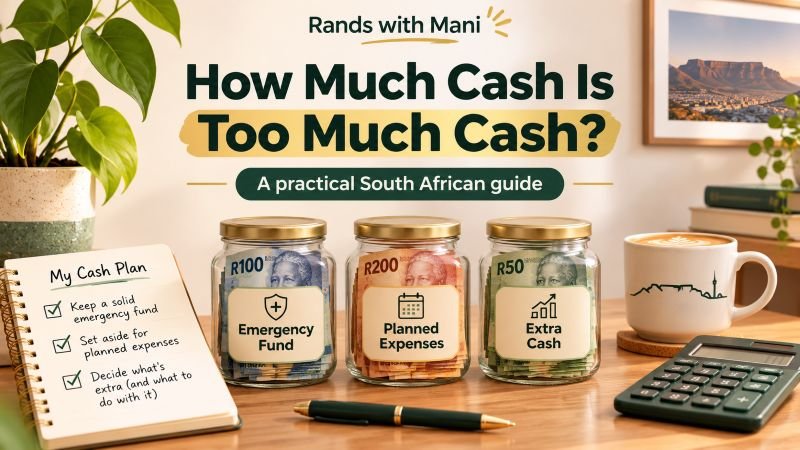
I like to think of cash as having three jobs: money for emergencies, money I already know I’m going to spend fairly soon, and a little extra that helps me sleep well at night.
Once those three jobs are covered, I start asking a different question:
Why is the rest still sitting in cash?
If I don’t have a good answer, that money may need a new job.
This question became very real for me
Before my husband died, I didn’t think about cash nearly as much as I do now. Money came in, bills were paid, some money was invested and cash was there for everyday life and unexpected expenses.
After he died, cash started to mean something different to me.
I was suddenly making all our financial decisions on my own while also thinking about my daughter, school fees, property, future expenses, investments and simply making sure that whatever happened next, I could keep our lives running comfortably.
Cash stopped feeling like money that was “not invested”. It started feeling like security.
If something unexpected happened, I knew I could deal with it without immediately worrying about where the money would come from. If I needed to pay a large bill, I didn’t have to sell an investment. If markets fell, I could leave them alone.
That feeling mattered to me.
I also realised something slightly uncomfortable: you can understand perfectly well that long-term investments may grow more than cash and still feel much better when you log into your banking app and see a reassuring balance sitting there.
I certainly did.
Eventually, though, I started asking myself:
Okay, this cash makes me feel safe. But how much safety do I actually need?
That turned out to be a much more useful question than simply asking whether cash was “good” or “bad”.
Cash is not lazy money
Sometimes personal-finance advice makes it sound as though cash is money that has failed to find a better job.
I don’t see it that way.
Cash pays for the things happening now. It pays the plumber when something bursts, covers the bills if your income suddenly stops and gives you money for unexpected medical costs, car repairs or family emergencies.
It also protects your investments.
Imagine you have R100,000 invested and markets have a terrible month. Your investment temporarily falls to R80,000. Then your car needs a R30,000 repair.
If you have no cash available, you may have to sell part of your investment while it is down. If you have an emergency fund, you can pay for the car and leave the investment alone.
That is why cash matters.
The aim is not to keep as little cash as possible. It is to keep enough cash for the things that genuinely require cash, without accidentally leaving long-term money there for years simply because you haven’t decided what else to do with it.
How much cash should you keep in South Africa?
I find it easiest to divide cash into three imaginary buckets.
They don’t have to be three separate bank accounts. They are simply three different purposes for the money.
Bucket 1: The “something went wrong” money
This is your emergency fund.
It is there for the things you didn’t know were coming: your income stops, the geyser bursts, your car needs a major repair or something happens in the family and you suddenly need money.
You will often hear that an emergency fund should cover three to six months of expenses. I think that is a useful starting point, but it isn’t a rule.
Two households could both spend R30,000 a month and need completely different emergency funds. One might have two stable salaries. The other might depend on one income, be self-employed or have several people relying on that income.
Their risk is different, so their cash needs can be different too.
My own view of emergency money changed after losing my husband. I became far more aware of being the person responsible for keeping everything going for my daughter and me, so naturally my idea of “enough cash” became more conservative.
I’m completely comfortable with that.
An emergency fund isn’t there to win an investing competition. It is there so that when life goes wrong, the financial side of the problem doesn’t make everything worse.
Bucket 2: Money you already know you’re going to spend
This is the bucket people often forget.
Let’s say your household spends R30,000 a month and you already have R180,000 saved. You might think, “Great, I have six months of expenses. My emergency fund is sorted.”
But imagine you also know that over the next year you’ll spend R80,000 on school fees, R40,000 on travel and R30,000 on work around the house.
That is another R150,000.
Those expenses aren’t emergencies. You already know they’re coming.
If you invest that R150,000 in something that can rise and fall sharply, you could end up needing the money at exactly the moment the investment is down.
I treat this differently in my own life now. School fees are not an emergency. A holiday I’ve already planned is not an emergency. If I know I’ll need the money, I don’t want to depend on what markets happen to be doing when the bill arrives.
A simple rule I like is:
If I know I need the money fairly soon, its main job isn’t to make me rich. Its main job is to be there when I need it.
Bucket 3: The money that helps you sleep
This one is personal.
Your spreadsheet might tell you that you technically need R300,000 in cash, but perhaps having R400,000 available makes you feel much more comfortable.
Keep R400,000.
There is nothing wrong with that.
Money is supposed to make your life better. It shouldn’t make you anxious every time something unexpected happens.
Where I think we need to be careful is when the comfort buffer keeps growing without a reason. Money comes in from different places, interest arrives, a transaction completes and you tell yourself you’ll invest some of it “soon”.
Then one day you realise the cash balance is much bigger than you originally intended.
I’ve experienced that feeling myself. And strangely, I found that the bigger the cash balance became, the harder it felt to move money out of it.
If you transfer money from a bank account into an investment, the bank balance suddenly looks smaller. Emotionally, that can feel like the money has disappeared even though you haven’t spent a cent.
You’ve simply moved it from one place to another.
Obvious? Yes.
But I think a lot of us still feel it.
A very simple way to calculate your cash number
Here is the formula I would use:
Emergency money + money you know you’ll spend soon + your comfort buffer = your target cash amount
Let’s make it very simple.
Imagine your household needs R30,000 a month.
You decide you want nine months of expenses available in case your income suddenly stops.
R30,000 × 9 months = R270,000
You also know you’ll need another R150,000 over the next two years for planned expenses.
Then you decide that having another R80,000 sitting there would make you feel safer.
Add the three amounts:
R270,000 + R150,000 + R80,000 = R500,000
Your target cash amount is therefore R500,000.
Now imagine you actually have R800,000 sitting in cash.
You need R500,000, which means there is another R300,000 without an obvious short-term job.
The useful question is not, “Am I holding too much cash?”
It is:
What is that R300,000 for?
If you have an answer, fantastic.
If the answer is, “Nothing really, it’s just sitting there,” then it may be time to make a decision about it.
What does too much cash actually cost you?
Cash can be slightly sneaky.
When investments fall, you notice immediately. The numbers on the screen turn red and it feels unpleasant.
Cash doesn’t normally do that.
The number sits there looking calm and safe.
But cash has another risk: inflation.
Let’s make inflation really simple.
Imagine something costs R100 today.
If prices rise by 5%, next year that same thing costs about R105.
Now imagine your R100 in the bank earned 7%. Your R100 became R107.
You did make R7.
But the thing that used to cost R100 now costs R105, so in terms of what your money can actually buy, you’re only about R2 ahead before tax.
That is why I care about the return after tax and inflation, rather than simply looking at the interest rate advertised by the bank.
What different amounts of cash can earn
Let’s use a simple example where cash earns 7% a year.
These figures are before tax and are just illustrations.
| Cash held | Interest for the year at 7% | Approx. per month |
|---|---|---|
| R100,000 | R7,000 | R583 |
| R500,000 | R35,000 | R2,917 |
| R1,000,000 | R70,000 | R5,833 |
| R3,000,000 | R210,000 | R17,500 |
When I look at a table like this, I completely understand why people like cash.
Seeing interest arrive every month is satisfying. There is something very appealing about money quietly helping to pay your bills without you having to do anything.
I have had the same reaction when interest lands in an account: Great, that is one less expense I need to fund somewhere else.
But then I remind myself that I need to ask more than one question.
What tax will I pay on the interest? What is inflation doing? And if I don’t genuinely need all that money in cash, what might some of it become if it were invested for ten or twenty years?
That is where the decision becomes more interesting.
Don’t forget the tax on interest
In South Africa, interest is not automatically completely tax-free.
For the 2027 tax year, people younger than 65 receive an exemption on the first R23,800 of qualifying South African-source interest. For people aged 65 or older, the exemption is R34,500.
Anything above the relevant exemption may form part of your taxable income.
Here is an easy example.
Suppose you are under 65 and earn R70,000 of interest during the year.
The first R23,800 is covered by the exemption.
R70,000 − R23,800 = R46,200
That does not mean you pay R46,200 in tax.
It simply means the remaining R46,200 may be added to your taxable income and taxed according to your own tax position.
So two people earning exactly the same amount of interest could end up keeping different amounts after tax.
That is why I prefer comparing investments based on what I actually keep, not just the headline return.
Does this mean you should invest every spare rand?
Definitely not.
That would just replace one extreme with another.
Imagine you work out that you need R500,000 in cash and you currently have R900,000. You have R400,000 above your target.
I am not saying you should move R400,000 into shares tomorrow morning. I would first ask what that R400,000 needs to do.
Perhaps some of it will be needed in four years. Perhaps part of it should go towards longer-term investments. Perhaps you want some offshore exposure. Perhaps you want to invest gradually because putting the whole amount into markets at once would make you uncomfortable.
All of those choices are reasonable.
The useful breakthrough is simply recognising:
This money no longer needs to be emergency cash. So what should its next job be?
That is a much calmer question than “Cash is bad, invest everything.”
Why do we end up with too much cash?
Sometimes we are simply afraid of losing money. A bank balance feels certain. Investments don’t.
If you put R100,000 into the market, there may be a month when the statement shows R92,000. Even if you understand perfectly well that markets move up and down, seeing that number can still feel awful.
Sometimes we are waiting for the “right time” to invest. I have done this too.
Markets look expensive, so you wait. Then they rise further, which makes them look even more expensive, so you wait again. Then someone predicts a crash.
Six months later, the money is still sitting in cash. And sometimes cash is emotional.
After my husband died, having accessible money gave me a sense of control at a time when so much in life had changed unexpectedly. Knowing that I could pay the bills, cover school costs, travel if I needed to or deal with an unexpected expense gave me comfort.
I don’t think we should dismiss that side of money. But eventually I had to learn the difference between:
“This money genuinely makes my life safer.”
and
“I’m keeping this money here because making the next decision feels uncomfortable.”
Those are not the same thing.
How can you tell if you have too much cash?
There are a few clues.
Your emergency fund is fully funded. Your known short-term expenses are covered. You still have a meaningful amount left over, but you have no particular reason for keeping it in cash.
Another clue is that you keep saying you will “invest it later”, but later never seems to arrive.
Or perhaps you already know the money is intended for something ten or twenty years away, yet it is still sitting in the same place as the money you use for normal monthly expenses.
None of this automatically means you are doing anything wrong. It simply means the money deserves another conversation.
What if you are a very cautious person?
Then keep more cash. I mean that. Your financial plan has to be one you can actually live with.
If you invest so aggressively that every market decline makes you panic and sell everything, then the strategy is not working for you, no matter how impressive it looked on a spreadsheet.
But I would distinguish between being cautious and doing nothing. You do not have to choose between a bank account and putting every spare rand into the stock market.
There is a whole world in between.
Money for emergencies can stay somewhere very safe. Money needed in a few years can take less risk. Money you genuinely won’t need for ten or twenty years can have more opportunity to grow.
One of the biggest lessons I have learned from managing my own money is that my entire financial life does not need one risk level.
Different money can do different jobs.
What if cash interest rates are really good?
Then enjoy them. There is nothing wrong with earning a good return on cash. But today’s interest rate is not guaranteed forever.
Banks change rates. The South African Reserve Bank changes interest rates. Economic conditions change.
That is why I would not decide how much cash I need purely because a savings account happens to pay an attractive rate today. I decide how much cash I need based on my life first.
Then I try to make that cash work as hard as reasonably possible while still keeping it appropriate for its job.
What about fixed deposits?
A fixed deposit may pay more interest than an account that lets you withdraw money immediately. That can be useful, but there is a trade-off.
Think of a fixed deposit like putting money into a cupboard and locking the door for a while. The bank may reward you with a better interest rate because you have agreed not to touch it.
That is fine for money you know you won’t need soon. It is not fine for the money you might need tomorrow.
You can also split your cash. Some can be available immediately, some can be fixed for a few months and some can be locked away for longer.
Again, every rand does not need exactly the same job.
Should your emergency fund be in a TFSA?
Personally, I would not use a Tax-Free Savings Account as my main emergency fund. A TFSA is valuable because your contribution room is limited.
Think of it as a special box that SARS allows you to fill only up to certain limits. If you keep putting emergency money into that box and then withdrawing it whenever something happens, you use up valuable contribution space.
I would rather use my TFSA mainly for money that I hope can stay invested for many years. Emergency money should usually be easy to access without interfering with a long-term wealth-building account.
A simple example
Let’s imagine you have R700,000 in cash.
Your household needs R30,000 a month for essential expenses.
You decide you want ten months of expenses available:
R30,000 × 10 = R300,000
You also know you’ll need R120,000 over the next couple of years for planned expenses.
Then you decide you want another R80,000 as a comfort buffer.
Add it together:
R300,000 + R120,000 + R80,000 = R500,000
Your cash target is R500,000.
But you have R700,000.
That leaves R200,000.
The question isn’t, “Should I invest R200,000 immediately?”
It is simply:
“What should I do with this R200,000?”
Maybe you invest it gradually. Maybe some goes towards long-term growth. Maybe some reduces expensive debt.
The important thing is that you noticed it no longer has a short-term job. Now you can make a deliberate decision instead of leaving it there by default.
What if the amount is much larger?
The same logic applies.
Suppose someone has R2 million in cash but works out that only R700,000 is genuinely needed for emergencies, planned expenses and comfort.
That leaves R1.3 million without an obvious short-term job. It doesn’t mean that person is “wrong” to have R2 million in cash. It simply means that the R1.3 million deserves a proper decision.
And the larger the amount, the more important that decision becomes because even a small difference in long-term returns can become a very large difference over ten or twenty years.
Cash gives you certainty today.
Long-term investing asks you to give up some of that certainty in exchange for the possibility of considerably more growth later.
Neither is automatically right or wrong. You simply need to know which job you are trying to do.
The question I now ask myself
I no longer look at a cash balance and ask:
“Is this too much?”
I ask:
“What is this money for?”
If I can answer that question, I’m usually comfortable.
This money covers emergencies. This amount is for school fees. This is for travel. This amount is deliberately waiting to be invested according to a plan.
All fine.
It is when I get to some money and think, I actually don’t know why that is still sitting there, that I know I need to make another decision.
My simple cash checklist
Before you decide whether you have too much cash, ask yourself:
- What does my household actually need each month?
- How many months of expenses would make me feel genuinely safe?
- What large expenses do I already know are coming?
- Is my income stable or unpredictable?
- Do I need an extra comfort buffer?
- What interest am I earning on my cash?
- How much tax might I pay on that interest?
- Is inflation reducing the real return?
- Do I have money sitting in cash that I won’t need for five, ten or twenty years?
- Am I holding the extra cash because I need it or because deciding what to do next feels uncomfortable?
You do not need a complicated spreadsheet to begin.
A piece of paper will do.
Write:
Cash I have: R______
Then:
Cash I actually need: R______
Subtract one from the other.
Whatever is left is the money that deserves another conversation.
So, how much cash is too much cash?
Too much cash is not automatically R100,000, R500,000 or R1 million.
Someone with R1 million in cash may genuinely need all of it. Someone else with R200,000 might be keeping more cash than their life actually requires.
For me, the simplest definition is:
Too much cash is money that has been sitting around for a long time without a clear short-term job.
Cash is there to give you security.
Long-term investments are there to help build your future.
Most of us need both.
The important part is knowing where one job ends and the other begins.
One final thought
I used to think the smartest financial decision was probably the one that produced the highest return. Life has changed my view of that.
I now place much more value on peace of mind. There is real value in knowing you can pay an unexpected bill tomorrow, cover your child’s expenses and live for a period without being forced to sell an investment.
That security matters to me far more than it used to.
But I have also learned that keeping every spare rand safe forever can become its own kind of risk. Some money needs to protect your present. Some money needs to build your future.
And sometimes the hardest part is simply deciding which is which.
Smarter money. Bigger life.
— Mani, CA(SA)
Have you recently received a large amount of money?
If your cash came from an inheritance, property sale, bonus or another lump sum, read:
You’ve Received a Lump Sum in South Africa. What Should You Actually Do With It?
In that article, I walk through how to decide what to keep in cash, what to invest, what to pay off and how to think about creating an income from your money.
And if your whole financial life feels like it could use a reset, download my free South African Money Reset.
It walks you through seven practical steps to understand where you are, build a safety cushion, organise your money and start building wealth with more clarity.
Rands with Mani provides general educational information and does not provide personalised financial, investment, legal or tax advice. Tax and investment outcomes depend on individual circumstances. If you need advice specific to your situation, consider consulting an appropriately qualified tax professional or authorised financial services provider.