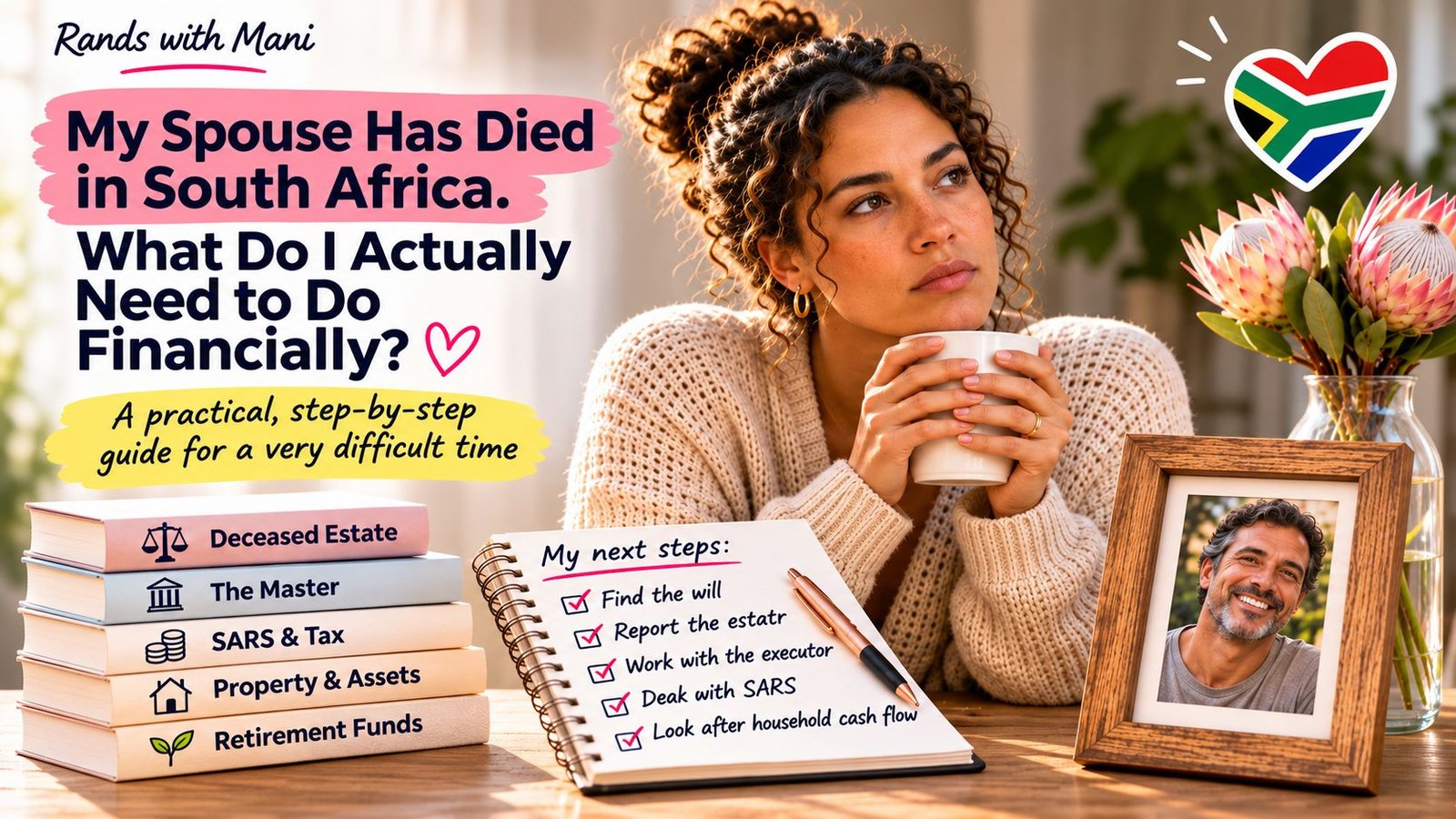
My Spouse Has Died in South Africa. What Do I Actually Need to Do Financially?
Bank accounts, the will, the Master, SARS, property, investments, retirement funds — this is the practical South African guide I wish someone had handed me when my husband died.
The first thing I wish someone had told me
If you’re wondering what to do when your spouse dies in South Africa, the first thing to know is that you do not need to solve the entire estate in the first week.
When your spouse dies, there is an almost surreal collision between grief and administration.
One part of you is trying to understand how the person who was there yesterday is suddenly not coming home. At the same time, another part of your life starts filling up with death certificates, certified IDs, bank forms, emails, policies, wills, tax questions and people asking you for information you may not even know exists.
I found that combination incredibly strange.
I am a Chartered Accountant. I have spent more than twenty years working with finance, accounting and numbers. I am comfortable with complicated financial information.
But this was different.
Knowing finance did not mean I automatically knew how to wind up my husband’s estate, what happened to every account after death, which assets actually formed part of the estate, what SARS expected, what happened to foreign assets or when I was legally allowed to do something as executor.
And, of course, I was trying to learn all of this at exactly the point in my life when my brain was least interested in learning anything.
That is why I wanted to write this article.
Not as an estate lawyer. Not as somebody pretending there is a neat checklist that makes bereavement manageable.
But as a wife who went through it, a Chartered Accountant who needed to understand it, and a mother who suddenly realised that I was now responsible for getting all of this right for my daughter and myself.
If your spouse has just died, you do not need to solve the entire estate this week.
You need to keep your household functioning, find the important information, establish who has legal authority to deal with the estate, report the estate properly and then start working through it.
One piece at a time.
Your spouse’s money does not immediately become your money
This was one of the first things I had to get my head around.
When someone dies, their deceased estate comes into existence. Even if the will ultimately leaves most or all of the assets to you, that does not necessarily mean you can start moving those assets into your own name the next morning.
There is a legal process between:
“My husband owned this.”
and:
“This now legally belongs to me.”
That distinction matters.
The estate is effectively frozen at death. The deceased person’s assets cannot simply be dealt with by whoever happens to know the banking password or believes they are the beneficiary.
And that can feel deeply unnatural.
You may have spent twenty years making financial decisions together. You may know every PIN. You may have regarded your finances as “ours” throughout your marriage.
Then suddenly an institution is telling you that you cannot simply access something you thought of as family money. It can feel incredibly bureaucratic at a time when you have very little patience for bureaucracy.
But understanding this early will prevent a lot of problems later.
Do not carry on using their accounts as though nothing happened
One of the most practical things I can tell a surviving spouse is this: do not continue using your late spouse’s bank card, moving money out of their account or distributing assets because you know where they will eventually go.
Even if your intention is completely innocent.
Even if the will says everything goes to you.
Even if you are the person nominated as executor.
Being named as executor in the will is not quite the same as being legally appointed as executor by the Master of the High Court.
The formal appointment is what gives you authority to act on behalf of the estate. That was an important distinction for me.
At the beginning, I thought of the estate in very ordinary terms: This was ours. I am his wife. The will says I am the executor.
But estate administration has its own rules.
Once I accepted that, I stopped trying to think of everything as “my husband’s things that now need to come to me” and started thinking of the estate as something I had a legal responsibility to administer properly.
That change in mindset helped.
So what should you actually do first?
If a friend called me tomorrow and said, “My husband has died. I don’t know where to start,” I would not send her a forty-page deceased-estate checklist.
I would tell her to focus on three things first:
Keep the household functioning. Find the information. Protect the assets.
Make sure you have access to enough money that legally belongs to you to pay the ordinary bills. Find the will and important documents. Start making a list of accounts, investments, property, insurance, retirement funds and debts.
You do not need to know the exact market value of every ETF on day three. You simply need to know that the account exists. That is an important difference.
When you are grieving, even small administrative tasks can feel enormous. Breaking the estate into pieces made it much easier for me than looking at it as one giant problem called “Sort out my husband’s estate.”
That problem was too big.
“Find the will” was manageable.
“Email the bank” was manageable.
“Check whether there is an offshore account” was manageable.
Eventually all those smaller tasks start forming the estate.
Find the original will
If there is a will, find the original.
Not just a scan sitting in your email.
Not the PDF you once sent to somebody.
The original signed document matters.
And if you are reading this article while both spouses are alive, please do yourself a favour and answer this question today:
Where is our original will physically kept?
Not “We have wills.”
Where are they?
Which drawer? Which safe? Which lawyer? Which bank? Who drafted them?
I now understand why this matters so much.
When somebody dies, the surviving family should not have to search through cupboards, old email attachments and boxes while wondering whether they are holding the legally important version.
Estate planning sometimes looks very sophisticated from the outside.
In reality, one of the greatest gifts you can leave your family is simply making your paperwork easy to find.
The estate must be reported to the Master
The next big step is reporting the deceased estate to the Master of the High Court.
South African estates that need to be reported should generally be reported within 14 days of death.
The reporting documents can include the death certificate, death notice, marriage information, the original will, an initial inventory of assets and information about creditors.
There is also an important distinction based on the size of the estate.
For estates above R250,000, the full executor process generally applies and the Master issues Letters of Executorship.
Smaller qualifying estates can follow a simplified process where a representative is appointed under section 18(3) and receives Letters of Authority.
For many families who own property, have investments or other meaningful assets, the estate will fall into the full process.
This is where the word executor suddenly stops being something you saw in your will years ago and becomes an actual job.
What does an executor really do?
Before I became one, I think I vaguely imagined that the executor made sure the will was followed.
That is true. But it is only a tiny part of the job. The executor has to build the financial picture of the person who died.
What did they own?
What did they owe?
What income is still coming in?
Who has a claim against the estate?
What needs to be sold?
What should be transferred?
What does SARS need?
What expenses has the estate paid since death?
What does each beneficiary eventually receive?
You are essentially closing down one person’s entire financial life.
When I started looking at it that way, I understood why the process took time. It also made me very aware that my role as executor was not always the same as my role as wife or beneficiary.
There were decisions where I had to stop thinking:
“What would I personally like to happen?”
and ask instead:
“What am I required to do properly as executor?”
That separation can be difficult when you are wearing all three hats at once.
What does the estate process actually look like?
This is the part I desperately wanted somebody to explain to me in plain English.
Here is the simplified version:
| Stage | What is happening |
|---|---|
| 1. Report the estate | The death, will, marriage information and initial asset information go to the Master |
| 2. Executor is appointed | The Master gives the executor formal authority |
| 3. Find and value everything | Bank accounts, investments, property, vehicles and other assets are identified |
| 4. Identify creditors | Creditors are formally invited to submit claims |
| 5. Sort out SARS | Tax up to death and tax arising during the estate are dealt with |
| 6. Prepare the L&D Account | The executor sets out everything the estate owns, owes and will distribute |
| 7. Inspection period | The account is advertised and made available for inspection |
| 8. Distribution | Once everything is approved, assets can finally be transferred to beneficiaries |
There are legal waiting periods built into this.
Creditors are given time to lodge claims. The Liquidation and Distribution Account has to be prepared and examined. It must eventually lie open for inspection.
So if you are six weeks into the estate and wondering why everything is not finished yet, that does not automatically mean somebody is incompetent.
Some things simply cannot happen immediately.
Why does it all take so long?
This was frustrating for me. From the outside, an estate can look straightforward.
There is a will.
There are assets.
There are beneficiaries.
So why can’t everyone just receive what the will says? Because before the executor gives anything away, they need to know what the estate owes.
Imagine distributing the money and later discovering a large SARS liability. Or transferring a property and then discovering a valid creditor claim. Or paying beneficiaries and finding an overseas account nobody knew existed.
The executor needs the full picture before the final distribution. That is sensible. It just does not feel particularly sensible when you are the person waiting.
Create one spreadsheet for the whole estate
This was probably one of the most useful things I did.
I had information coming from banks, investments, property, employers, advisers and different countries. If I had tried to hold all of that in my head, I would have lost track almost immediately.
So I created a master list.
If I were doing it again, the columns would look something like this:
Asset / liability | Institution | Account number | Estimated value | Contact person | Death reported? | Documents sent | Outstanding items | Current status | Beneficiary
Then I would add absolutely everything.
Bank accounts and fixed deposits.
Credit cards and loans.
Properties and vehicles.
Share portfolios.
EasyEquities or other investment platforms.
Offshore broker accounts.
Retirement funds.
Employer share schemes.
Life policies.
Company interests.
Crypto.
Foreign bank accounts.
Anything you think might matter goes on the list. You can work out later whether it falls into the estate. The bigger risk is not knowing it exists.
And there is something unexpectedly comforting about turning chaos into a spreadsheet. It does not fix the loss. But it gives you somewhere to put the information when your brain has had enough.
Bank accounts can create an immediate cash-flow problem
This is one of the things couples do not talk about enough. A family can be financially secure and still have a cash problem after one spouse dies.
You may own a valuable home. There may be investments. There may be retirement benefits and life insurance coming.
On paper, everything looks fine.
But the debit orders still run next week.
School fees are still due.
The electricity still needs to be paid.
And estate assets are not necessarily immediately available.
That is why I now think every couple should ask themselves something slightly uncomfortable while life is still normal:
If one of us died tomorrow, could the other one run the household for the next few months using money they can legally access themselves?
If the answer is no, that is worth fixing.
Not someday.
While both of you are alive and can still do something about it.
What if you genuinely need money from the estate?
If cash flow is a problem, speak to the executor rather than trying to solve it informally.
South African estate law does allow, in certain circumstances and with the Master’s consent, for the executor to release money or property for the subsistence of the deceased’s family before the estate is finally distributed.
That does not mean the surviving spouse can simply withdraw money. It means there are lawful mechanisms that may help where a family genuinely needs support.
This distinction matters. There is usually a proper way to solve an estate problem. You just have to know to ask.
What happens to the house?
This can become one of the most emotional parts of the estate. A house is not just bricks and a valuation.
It may be where you raised your children.
It may be something you renovated together.
It may contain all the plans you thought you still had years to live.
So when somebody asks, “Are you going to sell it?”, the question can feel much bigger than a property decision.
I understand that. But eventually the estate still needs practical answers.
Does the will leave the property to somebody?
Can the estate afford to hold it?
Is there a bond?
Who is paying rates, levies, insurance and maintenance?
Is it generating rental income?
Does the estate need to sell it to pay debts or tax?
Or can it be transferred to the surviving spouse or another beneficiary?
There is no rule saying you must make the emotional decision quickly simply because the legal process has started. Sometimes the best financial decision is to wait until you can see the situation more clearly.
The same applies to investments
Death does not automatically mean that every share, ETF or investment portfolio should be sold. That sounds obvious, but administration can create pressure to simplify everything.
Sell the portfolio.
Turn it into cash.
Distribute the cash.
Easy.
But “easy to administer” and “best financial decision” are not necessarily the same thing. Before selling a meaningful investment portfolio, I would want to understand the will, the beneficiary, the estate’s cash requirements and the tax consequences.
If a portfolio can be transferred and the beneficiary intends to remain invested anyway, selling everything simply because somebody finds it administratively convenient deserves a proper discussion.
Estate administration should not accidentally become investment advice.
Retirement funds work differently from most estate assets
This surprises many families.
A pension, provident fund or retirement-annuity death benefit does not necessarily follow the will in the same way as a normal investment account.
Where section 37C of the Pension Funds Act applies, the trustees have to identify dependants and nominees and decide how the death benefit should be distributed.
So a beneficiary nomination matters, but it does not necessarily mean:
“The form says 100% to my wife, therefore the wife automatically receives 100%.”
The fund has its own legal process. And that process can take time. This is one of the reasons beneficiary nominations should still be kept up to date while you are alive.
You may not completely control the eventual decision, but leaving outdated information certainly does not make life easier for the people who remain.
Life insurance needs to be checked separately too
Do not assume every life policy automatically becomes cash inside the estate. A policy may pay directly to a nominated beneficiary. Another policy may pay into the deceased estate.
The estate-duty treatment may also need to be considered. So when you find a life policy, ask a few basic questions:
Who owns it?
Who is nominated as beneficiary?
Who actually receives the proceeds?
Does it form part of the estate administration?
Does it affect estate duty?
Those questions are much more useful than simply writing “Life insurance: R2 million” on an asset list.
Do not forget the employer
This is an area I became very aware of through my own experience. A surprising number of financial benefits can sit with an employer after someone dies.
There may be final salary, unused leave, bonuses, deferred incentives, shares, retirement benefits, funeral cover, death-in-service cover or benefits for a surviving spouse or dependant.
Ask the employer for a written breakdown of every benefit arising from the death.
Not simply:
“Has everything been paid?”
Ask:
What benefits existed?
What was the entitlement?
Who administers each one?
What was paid?
How was it calculated?
Is anything still outstanding?
What documents are still required?
I learned that being politely persistent is sometimes essential. Do not assume that because nobody has mentioned another benefit, one does not exist.
Foreign assets make everything more complicated
If your spouse held money or investments outside South Africa, you may discover that the South African estate process does not automatically solve everything.
A foreign bank, brokerage account or property may have its own country’s inheritance or probate procedure. That can mean dealing with the South African executor for one part of the estate and a foreign lawyer, notary, institution or administrator for another.
This can feel like you are suddenly running two estates at once. Sometimes you essentially are. Cross-border estates are one of the areas where I would get professional advice early, particularly if there are meaningful assets involved.
The cost of good advice can be far lower than the cost of trying to untangle something later.
SARS was one of the parts I found unnecessarily confusing
When your spouse dies, their tax affairs do not simply disappear. There can effectively be two different tax periods to think about.
First, there is the deceased person’s tax position up to the date of death.
Then there can be the deceased estate’s tax position from the day after death while the estate is being administered.
That distinction sounds small. It is not. It can mean different returns, different periods and potentially a separate tax reference for the estate.
This was something I wish somebody had explained to me right at the beginning:
Tax before death and tax after death are two different conversations.
Once I understood that, SARS made a lot more sense.
Does SARS need to know about the death?
Yes.
The executor needs to make sure the deceased’s tax affairs are properly dealt with.
That can mean ensuring the death is recorded correctly, dealing with outstanding returns, submitting the final return up to the date of death and registering or dealing with the deceased estate for tax where it earns taxable income after death.
Do not assume SARS is automatically completely sorted because Home Affairs recorded the death. And do not leave tax until the very end. A SARS issue discovered late in the process can hold everything up.
Capital gains tax can happen even though nothing was sold
This is one of those tax rules that sounds slightly bizarre until you understand it. Death can trigger a deemed disposal of certain assets for capital gains tax purposes.
In other words, tax law can behave as though an asset was sold at market value on death even though nobody actually sold it. There are important exceptions and rollover rules, particularly where certain assets pass to a surviving spouse.
But the important point for an ordinary family is:
“Nobody sold anything” does not automatically mean “there is no capital gains tax issue.”
Death creates its own tax events.
Estate duty is different again
Estate duty is not capital gains tax. It is not income tax either. They are separate calculations.
For the 2026/27 year, estate duty applies at 20% on the first R30 million of dutiable value and 25% above R30 million.
But that does not mean an estate worth R10 million automatically pays estate duty on R10 million.
There are deductions.
There are liabilities.
There is the R3.5 million basic abatement.
There may be deductions for qualifying assets passing to a surviving spouse.
So if somebody casually tells you:
“Your husband’s estate is worth R10 million, therefore you’ll owe estate duty,”
do not panic.
The estate needs to be calculated properly first.
This is one of those areas where headline numbers can be very misleading.
Being the spouse can give important tax relief — but do not assume everything is tax-free
There are significant tax concessions where assets pass between spouses.
For example, certain capital-gains-tax rollover rules can apply when assets pass to a surviving spouse, and qualifying property accruing to a surviving spouse can qualify for estate-duty deductions.
That can materially reduce the tax bill. But I would not reduce that to:
“Everything goes to the spouse, so there is no tax.”
Estate tax is more nuanced than that. Get the calculation done properly.
What happens to rent, interest and other income after death?
Life does not freeze just because the estate has.
A rental property may continue producing rent.
Bank accounts may continue earning interest.
Investments may pay dividends.
At the same time, the estate may still be paying rates, levies, insurance, maintenance, accounting costs and other expenses.
That post-death income and expenditure needs to be tracked. This is another reason my spreadsheet became almost embarrassingly important to me. It did not make estate administration fun. Nothing was going to do that.
But six months later, when I needed to know why a particular amount had moved or what had been paid on a property, I had the answer.
When your life already feels uncertain, having one place where the numbers make sense is surprisingly comforting.
What is the Liquidation and Distribution Account?
The name makes it sound much more frightening than it is.
The Liquidation and Distribution Account — usually called the L&D Account — is essentially the formal financial story of the deceased estate.
It shows what existed.
What was owed.
What the estate paid.
What tax applies.
What is left.
And who receives it.
The Master examines the account. It eventually lies open for public inspection, and once the process is complete and any issues have been resolved, the executor can distribute the estate.
Once I understood the L&D Account like that, it stopped sounding like mysterious legal paperwork. The entire estate process is really moving towards this one document that says:
Here is the complete financial picture, and here is what happens to what remains.
Executor fees can be surprisingly large
This is another estate-planning detail most people ignore while they are alive.
If the will does not specify a different fee, the prescribed executor tariff can be up to 3.5% of the gross value of estate assets plus VAT, plus 6% of income collected after death, subject to the applicable rules.
On a large estate, that becomes real money.
For example, 3.5% of R10 million is R350,000 before considering VAT where relevant or fees on post-death income.
That does not mean executors should not be paid. Administering a substantial estate can involve an enormous amount of work.
But it does mean you should understand what your own will says about executor remuneration. This is exactly the sort of thing people discover only after someone dies.
I now think estate planning should involve reading the boring parts too.
Some of the hardest decisions are not really financial
There were assets I could look at objectively.
And then there were things connected to my husband.
Those were different.
A property you renovated together is not just “Property A: market value R___”.
An investment he always managed is not just another account.
The car somebody drove, the account where their salary used to arrive, the home you expected to grow old in — these things carry memories.
Closing them or selling them can feel strangely final. I found that difficult. What eventually helped me was changing the question.
Instead of asking:
“Am I emotionally ready to let this go?”
I tried to ask:
“What is the right decision for my daughter and me now?”
Sometimes the answer was to keep something. Sometimes it was to sell. And sometimes the answer was simply:
I am not ready to decide yet.
That is allowed too.
The estate has deadlines.
Your grief does not.
One of the best things I did was build my own estate command centre
I am calling it that now because “large collection of folders and spreadsheets created by a stressed accountant” does not have quite the same ring to it.
I had one place for official estate documents.
Another for tax.
Folders for major assets.
A master spreadsheet.
Contact names.
Reference numbers.
Dates.
Documents submitted.
Outstanding requests.
Follow-ups.
When an institution asked me for the same document again, I could see exactly when I had sent it before.
When somebody promised to get back to me, I wrote down the date.
That may sound slightly obsessive. It also saved my sanity. And if you are dealing with an estate now, I cannot recommend this enough.
Your brain should not have to remember every reference number while it is also grieving. Put the information somewhere else.
You are probably going to have to chase people
I wish this were not true.
But it was true for me.
One institution wants certified documents.
Another wants originals.
Another has its own deceased-estate form.
Another needs Letters of Executorship.
Another needs an apostille.
Another says they will reply and then vanishes into the mist.
Keep records.
Who did you speak to?
When?
What did you send?
What did they promise?
What is still outstanding?
Following up repeatedly can start making you feel like you are being difficult. You are not. You are trying to administer an estate. There is a difference.
What I would not do after a spouse dies
There are a few things I would be particularly careful about.
I would not keep using the deceased person’s bank accounts or cards.
I would not distribute assets before the executor has proper authority.
I would not assume the will controls retirement-fund benefits.
I would not sell a meaningful investment or property simply because somebody says it will make the administration easier.
I would not assume SARS is sorted automatically.
I would not forget about employer benefits, crypto or offshore assets.
And perhaps most importantly, I would not allow anybody to rush me into making a major financial decision simply because I was vulnerable and wanted the administration over with.
There is a difference between something being administratively urgent and something being financially urgent. Learning that distinction can save you from decisions you later regret.
When should you get professional help?
There is absolutely nothing wrong with asking for help.
Being appointed executor does not mean you personally need to understand every part of estate law, conveyancing, taxation and international succession.
If the estate has offshore assets, several properties, trusts, a business, complicated tax residency, a disputed will, foreign beneficiaries, liquidity problems or large potential tax liabilities, I would rather get appropriate specialist advice early.
Your job as executor is not necessarily to do everything yourself. Your job is to make sure it is done properly. I found that distinction freeing.
Going through an estate changes how you think about your own death
This was something I did not expect.
While dealing with my husband’s estate, I started looking at my own financial life through my daughter’s eyes. If I died tomorrow, would she — or whoever was looking after things for her — know where everything was?
Would they find my will?
Would they know about my offshore investments?
Would they know which bank accounts I had?
Would they know about insurance policies?
Could they find my tax information?
Is there enough accessible money to look after her while my estate is being administered?
Are my beneficiary nominations current?
Would my chosen executor know what they were walking into?
These questions are uncomfortable. But once you have been on the receiving end of an estate, you understand that organising your financial life is not really something you do for yourself.
You do it for the people who will be standing there when you are not.
If your spouse has just died, please start small
You do not need to understand everything today.
You do not need to know what a Liquidation and Distribution Account is before lunch.
You do not need to decide which property to sell.
You do not need to understand every SARS rule.
And you certainly do not need to become an expert in deceased estates while you are still trying to process what has happened to your life.
Find the documents.
Make sure you can pay the bills.
Find the will.
Start the asset list.
Work out who the executor is.
Report the estate.
Then take the next task.
And then the next one.
Eventually the giant, frightening thing called “my spouse’s estate” becomes a list of smaller problems that can actually be solved. I know because that is what happened to me.
One final thought
Before my husband died, a deceased estate was an accounting and legal concept to me. Afterwards, I realised that an estate is something much more human. It is a person’s entire financial life being taken apart, recorded and handed over to the people they loved.
The house on the inventory is a home somebody lived in. The retirement fund represents decades of going to work. The share portfolio may contain money somebody quietly invested every month for years.
The life policy exists because, at some point, that person thought:
If something happens to me, I want my family to be okay.
And the bank account isn’t just an account number. It is where ordinary life happened.
Groceries.
School fees.
Holidays.
Bills.
Plans.
That is why I wanted the first article in Death & Taxes to feel different from the estate guides I found myself reading.
You absolutely need the rules.
You need SARS.
You need the Master.
You need the forms and the legal process.
But you also need somebody to acknowledge that you are trying to do all of this while your entire life has just changed. If that is where you are right now, there is a process. You do not have to see the whole road yet.
Just deal with the piece in front of you.
Then the next one.
And slowly, unbelievably, things do start getting done.
Smarter money. Bigger life.
— Mani, CA(SA)
Where to go next
If you have already received money from an estate and are wondering what to do with it, read:
You’ve Received a Lump Sum in South Africa. What Should You Actually Do With It?
Rands with Mani provides general educational information and does not provide personalised legal, tax, estate-planning or financial advice. Deceased estates can differ materially depending on the will, marriage regime, tax residence, ownership of assets, beneficiaries and other circumstances. Consider using an appropriately qualified estate, tax or legal professional where your situation requires it.
